
In response to the growing demand for 21st-century skills — including critical thinking, adaptability, and emotional intelligence — the global education community is actively seeking tools that can transform learning processes. Addressing this need, the Smart Moves Summit 2025 took place on August 4–5 in Washington, D.C. and Alexandria, bringing together participants from around the world: education leaders, IT developers, innovative teachers, and FIDE experts. The event aimed to develop a roadmap for integrating chess into national curricula. Attendees emphasized that this discipline — combining logic, creativity, and strategic planning — offers a compelling answer to the challenges of the digital age, including fragmented attention, growing academic underachievement, and the need to build resilient cognitive skills.
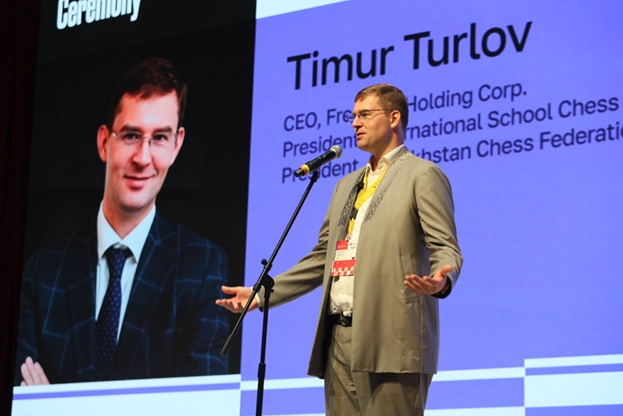
Timur Turlov and Jamie Raskin: Educational Landscape and Chess Innovation
Opening the summit, Timur Turlov, President of the Kazakhstan Chess Federation, addressed the systemic issues that have been intensified by the pandemic and digital transformation:
“Falling student motivation, the gap between theory and practice, and the lack of tools to develop metacognition all demand a systemic response. Chess, historically known as ‘gymnastics for the mind,’ is now becoming a bridge between classical pedagogy and the demands of the digital era. In Kazakhstan, introducing chess into schools has not only improved performance in math and logic, but also taught students to anticipate the consequences of their decisions — a critically important skill in today’s rapidly evolving world.”
Maryland Congressman Jamie Raskin emphasized the role of chess-based educational programs in shaping youth development:
“Humanity faces three fundamental choices. First: will we cultivate critical thinking among young people, or allow dogma, propaganda, fake news, and conspiracy theories to flourish? Second: will we teach strategic planning and scenario-based reasoning, or promote impulsive, reactive behavior? And third: will we champion diplomacy, logic, and reason — or embrace violence, recklessness, and aggression?”
FIDE President Arkady Dvorkovich added historical perspective and stressed the continuity of current efforts:
“In the Soviet Union, chess was viewed as a tool for developing strategic thinking, and school championships became embedded in the education culture. Today, through the establishment of the International School Chess Federation, we’re not reinventing the wheel — we’re systematizing accumulated experience. For example, in Latvia and Armenia, programs are tailored to local needs: some emphasize logic, others focus on teamwork.”
He further highlighted the importance of balancing universal principles with cultural specificity, ensuring that chess remains an accessible tool for all regions.
Technology and the Human Element: Striking a Balance
The session on digitalization sparked an engaging debate on the role of technology in education. Participants acknowledged that AI-powered chess strategy platforms and VR-based tournament simulations are highly effective for tactical training. However, Arkady Dvorkovich cautioned against overreliance on tech:
“Digital tools can’t replace human interaction. After a game, students discuss mistakes, learn to justify their moves, and process defeat — this fosters emotional intelligence. Even the most advanced chatbot cannot replicate the experience of a mentor explaining why a certain move led to a loss and how to avoid it in the future.”
Experts also addressed the shortage of qualified educators. Online platforms were showcased where teachers receive training to incorporate chess-based exercises into math or history lessons. However, attendees agreed that without in-person workshops and mentorship, such programs often fall short in effectiveness.
During the panel on government policy, representatives from various countries shared experiences integrating chess into national education systems. Timur Turlov focused on the importance of strategic planning:
“Just like in a chess game, where every move shapes the outcome, educational initiatives require long-term vision. Investing in human capital today defines economic prosperity tomorrow. In Kazakhstan, we’re not just adding chess classes — we’re training teachers, developing instructional materials, and closely monitoring the program’s impact on cognitive development. Without this systematic approach, even the most ambitious projects risk remaining isolated experiments.”
Expert Participation and International Collaboration
The summit served as a platform for dialogue among key players in educational innovation. Alongside Timur Turlov, Jamie Raskin and Arkady Dvorkovich, other contributors included:
- Jerry Nash (USA), Chair of FIDE’s Chess in Education Commission, who presented global standards for teacher training, including modules on age-specific psychology and digital literacy;
- Rita Atkins (UK), ChessPlus expert, who explored methods for integrating chess into STEM disciplines — for example, using board positions to teach algorithmic thinking;
- Dana Reizniece-Ozola (Latvia), FIDE Deputy Chair, who analyzed the relationship between education programs and economic policy using Baltic countries as case studies;
- Jenny Ingber (USA), President of Chess in the Schools, who shared how combining chess instruction with academic tutoring is helping students from underserved areas of New York improve their school performance.
Outcomes and Future Outlook: A Roadmap Through 2030
At the conclusion of the forum, participating countries signed the Washington Declaration, committing to include chess in national education standards by 2030. The agreement outlines the formation of national working groups, development of curricula, and regular monitoring of outcomes. A global task force supported by UNESCO was established to coordinate efforts, collect best practices, and share them among member states.
Arkady Dvorkovich noted:
“We will not wait for perfect conditions. As in chess, adjustments will be made as programs evolve. Next year, we’ll launch a platform for teacher collaboration and a series of webinars on incorporating chess into interdisciplinary projects.”
Organizers announced Smart Moves Summit 2026 will be hosted in Singapore, where the focus will shift to neurotechnology and cognitive research.
Timur Turlov emphasized:
“The next stage will require uniting the efforts of scientists, educators, and IT professionals. We aim to present studies on how chess affects brain neuroplasticity and discuss how VR technologies can enhance traditional learning methods. Only by combining centuries-old traditions with innovation can we build an education system equipped for the challenges of the future.”
Forum participants agreed that chess, long revered as an intellectual pursuit, is gaining renewed relevance in the age of digital transformation. It not only strengthens cognitive skills but also teaches students to make informed decisions in uncertain environments — a vital trait for success in any professional field.
