Key Takeaways
- SD-WAN delivers centralized management, dynamic routing, and increased efficiency for enterprise networks.
- Integrates security technologies, including Zero Trust Network Access and Secure Web Gateway, for modern threat protection.
- Plays a crucial role in seamless and scalable cloud integration.
- Reduces operational costs by leveraging affordable links and optimizing bandwidth utilization.
Table of Contents
- Introduction to SD-WAN
- Key Benefits of SD-WAN
- SD-WAN and Network Security
- SD-WAN in Cloud Integration
- Cost Efficiency and SD-WAN
- Real-World Applications of SD-WAN
- Future Trends in SD-WAN
- Conclusion
Modern enterprises require resilient, high-performing, and secure networks to support their digital transformation initiatives and ongoing operations. With distributed teams and an ever-increasing reliance on cloud applications, traditional networking solutions often struggle to keep up. Software-defined WAN infrastructure for connecting users across any network type has become a pivotal technology, enabling organizations to streamline their network management, enhance application performance, and safeguard data while supporting rapid scale and change.
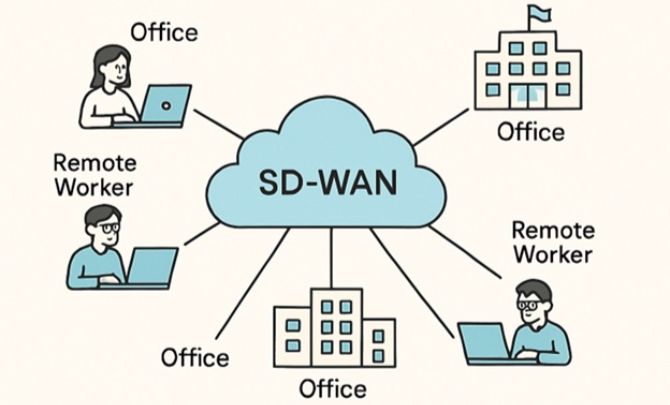
Centralized control, dynamic traffic management, and integrated security separate SD-WAN from legacy solutions. These capabilities allow businesses to respond to evolving user demands and changing traffic patterns, ensuring connectivity remains strong across branches, remote workers, and cloud resources. As enterprises migrate away from rigid MPLS contracts and static configurations, SD-WAN solutions empower IT leaders with agility and efficiency previously out of reach. SD-WAN’s unified approach is redefining network architectures, making them fit for a cloud-first future.
For a comprehensive perspective on recent developments shaping enterprise networks, major IT publications such as TechRepublic regularly report on SD-WAN trends, benchmarks, and success stories.
Introduction to SD-WAN
Software-Defined Wide Area Networking (SD-WAN) leverages software abstraction to decouple a network’s control mechanisms from its hardware. Instead of configuring each branch router individually, IT teams manage the entire network via a centralized dashboard, automating configurations and orchestrating connections across multiple transport methods—such as broadband, wireless LTE/5G, and traditional MPLS lines. This programmability simplifies troubleshooting, accelerates new site rollouts, and ensures that business-critical applications always receive the necessary resources.
Key Benefits of SD-WAN
- Centralized Management: All network policies, updates, and configurations are performed through a single interface, reducing complexity and errors caused by manual intervention.
- Dynamic Traffic Routing: SD-WAN monitors real-time network conditions and routes application traffic based on current performance, prioritizing latency-sensitive apps and automatically redirecting traffic around congestion or outages.
- Improved Performance: The ability to combine and route traffic across multiple WAN links enhances uptime and minimizes disruptions for business applications, regardless of the location from which users connect.
- Scalability: Expanding to new offices, adding users, or integrating new cloud services is streamlined, thanks to SD-WAN’s zero-touch provisioning and flexible architecture.
SD-WAN and Network Security
The security landscape is evolving as threats become more sophisticated and persistent. Unlike legacy WANs, modern SD-WAN solutions are designed with security embedded in their core. Techniques such as encrypted tunnels, application-aware firewalls, and network segmentation mitigate risks without sacrificing speed or user experience.
Integrated Security Features
- Zero Trust Network Access (ZTNA): Restricts access based on identity and policy, ensuring users, devices, and apps must be verified before gaining access.
- Secure Web Gateway (SWG): Prevents data breaches by inspecting outbound and inbound internet traffic, blocking malicious sites and unsafe downloads.
- Next-Generation Firewall (NGFW): Detects and stops advanced threats using deep packet inspection, intrusion prevention, and behavioral analytics.
Combining these controls positions SD-WAN as a powerful line of defense for today’s geographically dispersed organizations. For further insights into enterprise security and SD-WAN, explore features and analyses on Network World.
SD-WAN in Cloud Integration
Businesses are transforming their workflows by embracing SaaS platforms and migrating key infrastructure to public, private, or hybrid clouds. SD-WAN optimizes the user experience by creating direct, secure pathways to these applications, often bypassing traditional data center backhauls. This “cloud on-ramp” reduces round-trip latency and network chokepoints, ensuring that mission-critical apps like Microsoft 365, Salesforce, or AWS-based tools remain available and responsive.
Additionally, SD-WAN provides visibility and policy enforcement across all cloud traffic, simplifying compliance and risk management. Whether supporting dozens or thousands of users across multiple continents, SD-WAN delivers the flexibility and reliability essential for cloud-first operations.
Cost Efficiency and SD-WAN
One of SD-WAN’s early promises was to reduce reliance on costly MPLS circuits. By layering broadband and wireless connectivity with traditional networks, organizations can reduce overall spend, balance loads efficiently, and maintain high uptime—even if a single transport method fails. Automated provisioning and network monitoring further reduce the operational burden on IT teams, resulting in decreased downtime and fewer troubleshooting hours.
The ability to quickly scale bandwidth during seasonal spikes (such as retail holidays or tax deadlines) minimizes overspending on unused capacity the rest of the year. As a result, SD-WAN shifts WAN budgeting from inflexible CapEx to predictable, right-sized OpEx.
Real-World Applications of SD-WAN
Organizations in every vertical—finance, logistics, retail, healthcare, and more—are leveraging SD-WAN to reshape their network strategy. A notable example is a global logistics firm with hundreds of branch offices worldwide. Replacing their legacy MPLS contracts with a virtual SD-WAN overlay led to a dramatic boost in site-to-site performance, lower operational costs, and improved failover capabilities for critical applications.
Retailers have simplified the complexity of deploying seasonal pop-up stores. At the same time, healthcare systems utilize SD-WAN to comply with privacy regulations by maintaining persistent, encrypted connections between clinics, hospitals, and cloud-based scheduling platforms.
Future Trends in SD-WAN
Looking ahead, SD-WAN is evolving rapidly in tandem with broader IT trends. Integration with Secure Access Service Edge (SASE) frameworks is producing holistic solutions where security and networking are inseparable, making them ideal for hybrid and remote-first workforces. Further, advanced analytics powered by AI and machine learning are being embedded, enabling networks to self-optimize, anticipate bottlenecks, and dynamically respond to security incidents without human intervention.
The continued convergence of connectivity, security, and intelligence within SD-WAN platforms promises to make future enterprise networks even more responsive, manageable, and safe—cementing SD-WAN’s role at the heart of digital business strategy.
Conclusion
SD-WAN empowers modern enterprises to adapt quickly to changing market needs, securely embrace cloud services, and maximize every IT dollar. As networks become more crucial than ever, investing in robust, integrated solutions like SD-WAN positions organizations to thrive amid digital disruption, supporting productivity and innovation at scale.
